
Trends in the Higher Education Sector
South Africa has the strongest higher education (HE) sector in Africa, with nearly 900,000 students enrolled in public universities in 2010 and nearly 1 in 5 young South Africans entering higher education. Our HE sector is still relatively small compared to the 2.1 million and 19.1 million students enrolled for study on HE courses in the UK and US respectively in 2010/11. However, rapidly increasing student numbers year on year, high quality research output and the promise of better funding opportunities means that our HE sector is definitely a rising star!
What are academic libraries currently buying?
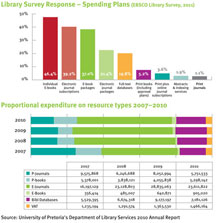
We can look to the US to try and understand future trends that might hit South Africa. According to the EBSCO Library Survey 2011, 82% of US academic libraries are moving to online only resources to alleviate pressure on budgets. Libraries also see spending on e‑books as still being in the infancy phase and they report that e‑books would see the greatest increase in expenditure. It is also to be expected that the largest part of library budgets would be spent on online journal subscriptions as prices continue to soar. As a result of this move to online only, spending on print resources seemed to be a low priority.
South African Universities are following suit with institutions such as the University of Pretoria spending more on online resources than print. The University of Pretoria Library Services (UPLS) has increased spending on e-journals by 31% and more importantly increased spending on e‑books by 60%.
What are libraries likely to buy in the future?
Another trend among US libraries that is gaining traction quickly is the purchasing of online data and digitized archive products. Among the 10 online resources that won the Choice’s Outstanding Academic titles award in 2012, three were data products and four were digitized archives for example ARDA: Association of Religion Data Archives and EVIA Digital Archive Project. These developments sprung from an increased interest in digital preservation and the advent of big data. Libraries are also likely to prioritize academic resources that have a mobile offering and many industry giants such as EBSCO, JSTOR, and Elsevier have mobile interfaces or apps.
What new business models do libraries prefer?
There is also a lot of experimentation with different payment options for e‑books at the moment but it seems as if patron driven acquisition is poised to become the norm. Developments relevant to journals include open access or the “author pays model”. The publication of the Finch report in the UK in 2012 indicated the Gold open access model as the preferred method of publication for publically funded research. This left many advocates of open access overjoyed and many policy makers scrabbling to determine if it would be viable for them to fit the bill. There is a very lively debate around the topic of open access and there is still a lot of work to be done to iron out the issues, however, many academic publishers have already started experimenting with this model with especially life science publishers seeing success.
This is definitely an exciting time to be part of the HE sector with many new developments on the horizon. Based on the trends that we can see in the US and South Africa, there is a clear shift in the HE industry towards online only and e‑books will continue to be a growth sector while journals will remain the bread and butter for academic publishers. Finally, continued innovation in online products and business models promises that 2013 will be another exciting year.
Ilse Gey van Pittius is well-versed in all things digital with previous experience working in the new product development department for a London based academic publisher as well as completing a Masters with specialization in ePublishing and International Business.

Leave a Reply
Want to join the discussion?Feel free to contribute!