
Literacies for the 21st Century
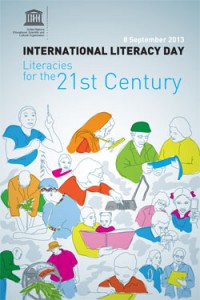
September 8 was proclaimed International Literacy Day by UNESCO on November 17, 1965. It was first celebrated in 1966. Its aim is to highlight the importance of literacy to individuals, communities and societies. On International Literacy Day each year, UNESCO reminds the international community of the status of literacy and adult learning globally. Celebrations take place around the world.
According to Wikipedia, “Some 775 million adults lack minimum literacy skills; one in five adults is still not literate and two-thirds of them are women;60.7 million children are out-of-school and many more attend irregularly or drop out.”
UNESCO’s Global Monitoring Report on Education for All (2006) states that “South and West Asia has the lowest regional adult literacy rate (58.6%), followed by sub-SAharan Africa (59.7%), and the Arab States (62.7%). Countries with the lowest literacy rates in the world are Burkina Faso (12.8%), Niger (14.4%) and Mali (19%). The report shows a clear connection between illiteracy and countries in severe poverty, and between illiteracy and prejudice against women.”
Celebrations of International Literacy Day have included specific themes, in line with Education For All goals and other United Nations programs such as the United Nations Literacy Decade. The celebration’s theme for 2007 and 2008 was “Literacy and Health”, with prizes awarded to organizations at the forefront of health education.This was also the thematic emphasis of the 2007-2008 biennium of the United Nations Literacy Decade.In particular, International Literacy Day 2008 had a strong emphasis on Literacy and Epidemics with a focus on communicable diseases such as HIV, Tuberculosis and Malaria, some of the world’s forefront public health concerns. For 2009-2010 the emphasis was placed on “Literacy and Empowerment”, with special consideration to Gender Equality and the empowerment of women. The theme of the 2011-2012 celebrations was “Literacy and Peace”.
The theme for this years International Literacy day is: Literacies for the 21st Century.
Literacy is a right and a foundation for lifelong learning, better well-being and livelihoods. As such it is a driver for sustainable and inclusive development.
Over the years, the notion of literacy has evolved. The conventional concept limited to reading, writing and numeracy skills is still in wide use, as well as the notion of functional literacy which links literacy with socio-economic development. But other ways of understanding “literacy” or “literacies” have emerged to address the diverse learning needs of individuals in knowledge-oriented and globalized societies.
Why do people need literacy skills? How is literacy shaped by culture, history, language, religion and socio-economic conditions? What are the impacts of technological advancement on literacy? Is it possible to determine in a diverse world a minimum set of basic literacy skills?
This year’s International Literacy Day is dedicated to “literacies for the 21st century” to highlight the need to realize “basic literacy skills for all” as well as equip everyone with more advanced literacy skills as part of lifelong learning.

Leave a Reply
Want to join the discussion?Feel free to contribute!