
Annual academic report August 2013 – July 2014
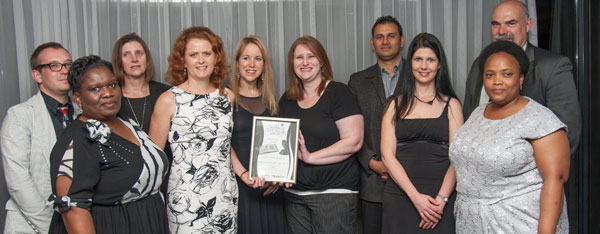
The Oxford University Press team. Winners of the Academic Publisher of the year award 2014. Voted for by booksellers.
2013-2014 has proven to be one of the most challenging for Academic Booksellers. It has been punctuated with the closure and sale of a bookstores/chains and uncertainty and changes with student funding models and technologies and enrollments. Strikes at various institutions were numerous and long.
These industry issues have been further exacerbated by external factors ranging from a sudden and substantial drop in the value of the Rand against our supplier currencies, protracted strikes in the mining and later the metal working industries, the introduction of the e-toll “tax” in Gauteng and the disruptive nature of national elections.
The Key events were:
1. The pilot by NSFAS of SBux as a payment mechanism for 6 major institutions including UNISA
This was at short notice in November and December 2013 and led to many concerns. The eventual roll out was technically very smooth but the distribution of funds and student communications were problematic.
2. Closure of Academic Bookstores were marked by the closure of a number of Juta stores prior to their sale. Further
3. The sale of Juta Bookshops to Protea Boekhuis marked the end of an icon in South African bookselling. It was however pleasing to see an existing member of the Association buy the chain of stores. It is a sign of the confidence our members have in the industry and their entrepreneurial spirit.
4. The conclusion of the private equity purchase of our largest Academic member Van Schaik was further evidence of the potential of our market despite all of the risks faced.
5. The pilot NSFAS roll out of a centralised system of approval and disbursement of funds has been difficult. While members have generally supported the system and the principles behind it the lower fund approvals and the delays in disbursement directly affected sales at many stores. The scale of the pilot by including UNISA was much bigger than proposed at our conference in 2013 and took many members by surprise.
6. Strikes and Industrial Action
Universities – Strikes at DUT, TUT and other institutions in the early part of 2014 have impacted sales. In some instances sales have been delayed/deferred if not lost.
Industrial Action – The protracted strike in the mining and related industries have impacted the economy with students, parents and companies having to adjust accordingly.
7. eTolls have had an effect on disposable income in the Gauteng region. This has appeared to impact on peoples disposable income and the general economy. Booksellers have been affected.
What has SA Booksellers Academic done?
1. Teleconferences:
A number of teleconferences were held during the course of the year. These were in line with our plan to communicate regularly across regions and the limited number of specialist Academic Booksellers.
We have been limited by the telecon to a max of 10 participants
During these meetings key factors have been discussed and information shared on industry developments
2. Meeting with NSFAS leadership:
This was a very positive meeting where we were able to share experiences with NSFAS and provide input into the way forward. A brief report on the meeting was circulated to regional Academic members.
3. Document submitted to HESA for consideration.
We are currently in the process of engaging with HESA to meet and present our perspectives on developments in higher Education. The objective is to share our “on the ground” experiences and knowledge with the leadership of Institutions and provide input toward their decision making.
4. SABA Conference Academic Meeting:
We have increased the participation of Publishers at this year’s conference Academic meeting to include a number of Non-PASA Publishers. We hope to grow this into a bigger and more interactive discussion and an opportunity to build our sector interactions.
We have also secured sponsorship of “goodies” from a few suppliers for our Academic meeting with a view that future meetings would have a greater “trade” and “product” element.
Way forward:
1. Teleconferences on a Quarterly Basis: We are planning to continue with national teleconferences on a quarterly or similar frequency. These appear to be the best way for our sector. The reduced number of members makes regional meetings less practical.
2. Workshops: Further to these teleconferences we may consider holding an academic sector “workshop” during our off-peak period. The intention is to create more opportunities for members to discuss industry specific issues and possibly engage in some training or seminars and to meet key role players and suppliers.
3. Interactions with stakeholders: The academic sector will make further efforts to engage with a cross section of stakeholders in the Academic space. While these interactions are difficult to arrange we need to proactively participate in and promote bookselling as a key element of the tertiary education value chain.
Conclusion:
2014-2015 will likely be another challenging year. It is up to our members to actively work to ensure that we are prepared and driving the industry. To this end a big thank you to our members for their time, participation and guidance over the year. We must also thank the members of the National Exco for their commitment, sacrifice, time and dedication. They do so knowing that it is often at a cost to their businesses and personal lives.
While we are competitors, by working together on an industry level we can work to grow our industry and share in its success, rather than compete over a diminishing market. Let us focus on “growing the cake” rather than redistributing a “shrinking cake”.
By Mohammed Kharwa , SA Booksellers
Vice President and Academic Chairperson

Leave a Reply
Want to join the discussion?Feel free to contribute!