
Annual president’s report August 2013 – July 2014
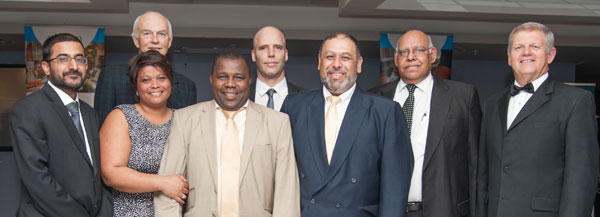
Attending SA Booksellers executive members at the Sefika awards this year. Front row: Mohamed Kharwa, Samantha Faure, Sydwell Molosi, Riaz Hassim, Back row: Peter Adams, Richard Hargraves, Guru Redhi, Hentie Gericke
The August meetings are always the highlight of the SABA year. They not only bring together our members but they enable us to exchange information and learn from the best informed speakers on some critical subjects and they give your executive guidance on what to do in the coming year.
This year they opened with the gathering of the academic booksellers and the joint meeting of those members with the publishers. For the first time in memory, there was general agreement that the total market had contracted significantly. Two factors contributing were the late disbursement of the important NSFAS bursary funds and the higher entry requirements for the large UNISA management courses and some others leading to much lower enrolments. Some universities had given students funding the previous year on the basis of allocations promised by NSFAS. Where these were not paid out, the Universities were out of pocket of large sums, and were unwilling to risk paying them out again. As the demand for funds had increased, and because the Department of Higher Education wishes to enable disadvantaged students to better themselves, the NSFAS funding had been increased this year, and we hope we will see greater purchases in the future. NSFAS is concerned about the amount of funds that are allocated and not spent, and we hope that it will be possible to distribute the funds early, when the students are buying their text books.
Copyright infringement remains a problem: The photocopy rooms at universities are among the busiest and a fair amount of the copying is in excess of what should reasonably be allowed. Illegal photocopying of whole books by copy shops and even the production of counterfeit books has been encountered. We are worried that the existence of legal digital books will give rise to more copying of whole books. This was done this year by well-meaning lecturers in a couple of cases and we, as an industry must make an active effort to discover abuses. SAFACT and DALRO are giving the publishers good support, and it was good to be able to talk to their representatives at the meetings.
Mohamed Kharwa arranged teleconferences for the academic booksellers last year, and if you would like to participate in these please contact him. (kharwa_m@provisions.co.za).
The school bookselling landscape is likely to be much affected by the Dept of Basic Education’s new National Policy for Procurement of LTSM. The document is not available as I write, but is likely to appear about the time of publication of this issue of Bookmark. It will incorporate the minister’s intention to approve the purchase of only one textbook in each learning area. Mr. Soobhun – the director in the Department who chairs the LTSM Committee meetings – said when he addressed us that the reason behind this was to get the best prices for the department so that it could fulfil its responsibility to give each student a book. In future there will be a greater effort made to retain at least 85% of books issued, and where there are shortfalls the pre-CAPS books would suffice as they also contained all that the students need to learn. He said that, as all the textbooks approved covered the syllabus, they were all equally acceptable, a point which booksellers find difficult to accept. We know that teachers have strong preferences when it comes to their text books, and these are based on the abilities of their students to use them. They would certainly not agree that “one book suits all.” We hope therefore that schools raising their own funds will continue to use a variety of books and that the booksellers will be needed to assist them.
In KZN the Department is hoping to buy the textbooks directly from the publishers to save the costs incurred using Edusolutions (or its successor) and also to cut down on the distribution costs. With this in mind, they are negotiating with publishers to deliver books packed by school to about fifty depots around the province, from where they will be collected by the schools. This will result in considerable savings and they hope that they will be able to overcome the practical problems foreseen by detractors.
Mr Soobhun’s address was one of the most important of the meetings. He encouraged booksellers to be more vocal in the LTSM committee meetings and to approach him with ways in which we would like to be involved. He also told us that the textbook needs would reduce as only top-ups would be purchased and that the Department was considering spending up to thirty percent of the book budget on library books. We share the publishers’ fear, however, that purchasing only one book for each subject will destroy many publishers – especially the small ones – and harm the industry terribly. And if the department tries to incorporate all the Sect 21 schools into its tenders and direct supply model, it will do equal harm to the bookshops.
Mr Benjamin Trisk addressed the Trade booksellers. What a treat it was for many to listen to a man who reads and loves his books, who believes that warm and welcoming booksellers and bookshops will continue to attract book lovers and who has a clear vision of how to create the right kind of shops to grow Exclusive Books’ sales. We share his view that a vibrant SABA is important for the South African trade and are delighted that Exclusive Books’ staff are playing a more active role in SABA. We are involved in a number of initiatives for the promotion of books and reading, and these initiatives will be more effective if better used by retailers big and small.
While there are undoubtedly many who prefer the real book, there is also a growing number of readers using the digital media. Constant developments are opening opportunities for the use of digital books in schools, universities and among general readers, and we ignore them at our peril. The afternoon given to speakers who opened our minds to present developments and the dreams and possibilities. John Jacobs, Alan Vesty, Ben Williams and Melvin Kaabwe are all paricipants in different areas of the digital book world and shared some of their ideas on what is happening. If any booksellers wish to be able to distribute books from the On the Dot Digital site, they should contact Ulandy Gribble who has a simple method for them to register and do so.
SABA thanks those who gave their time to attend the meetings. We wish to communicate more with our members and some ideas were presented at the meetings. Do remember, though, that we now have a website which is being updated regularly. Pass interesting information or articles to Jessica (bookmark@sabooksellers.com) for sharing with your community, and remember to login to the private part of the site to find the addresses of publishers who are not in the PASA directory but are in the Alternative Publishers’ Directory. You can get your login details from the SABA office.
Your executive looks ahead to a challenging year. If there are ways in which we can help you, do not hesitate to contact us through the SABA office. Participate in the affairs of your local branch: We each need to be a part of the solution to the challenges our industry faces.
Sydwell Molosi,
President, SA Booksellers Association

Leave a Reply
Want to join the discussion?Feel free to contribute!