
SA Book Market General Trade
October 2013 to October 2014 to include Christmas period 2013.
The year so far has been one of a weakening currency, tighter customer purse strings, Eskom black-outs and mall robberies. The spirit of bookselling nonetheless prevailed with a momentous comeback by Exclusive Books, continued expansion by Bargain Books and enduring independents.
On the content side, 2014 undoubtedly belongs to Zelda la Grange and Tim Noakes. The WW1 centenary saw a world-wide spike in interest and a spate of new books on the topic, with prominent international history authors visiting SA and bookshops featuring innovative displays.
General Trade Sales
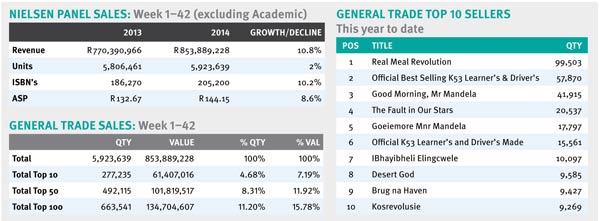
The general trade saw an increase in revenue in the first 42 weeks of the year, but sales remained flat in terms of units. This tells the story of a South African industry temporarily bolstered by price increases, while the true picture is not so cheerful. Interestingly, the trade sold a greater range of books over this period compared to the previous year, an indication perhaps of the renewed focus on range at Exclusive Books, but also of the greater range of panel sales now recorded by SAPnet with the addition of Bargain Books outlets.
Trade sector revenue was up by R83 498 262, mostly driven by price increases in the wake of the weakening Rand. The Rand lost 28% of its value against the GBP from February 2013 to January 2014. Since then the domestic currency has been volatile with spikes in May and early September and sharp declines in July and late September.
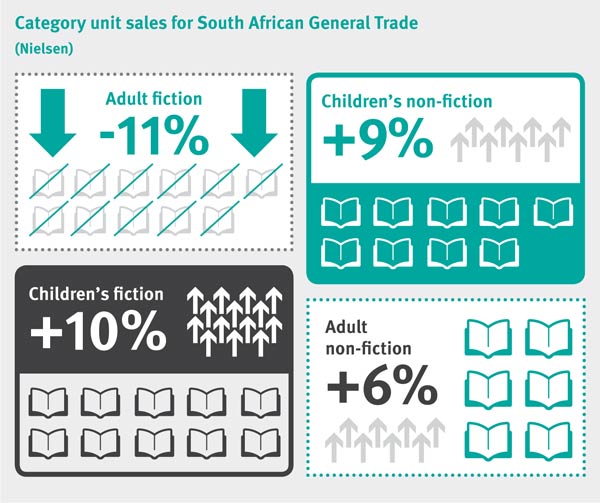
There is a small shift in market share percentage between Adult Fiction and Adult Non Fiction.
Specific genre unit sales saw Food & Drink more than double over 2013 (Tim Noakes), with significant growth in Autobiography (Good Morning Mr. Mandela). In fiction, Crime and Romance showed growth but General and Literary Fiction show a marked decline. Christian sales were up, but Business down.
Afrikaans sales in the general sector were flat year on year, with only marginal unit and value growth. Prices also remained flat.
The bread and butter of the general trade remains the range, with 88.8% of unit sales coming from titles below the top 100.
The trend in our market is not much different to the rest of the global markets.
“The traditional book markets are flat –some in decline; emerging markets are growing fast – India, China, Brazil; e-books will continue to grow-but pace of growth will be different in each market; Digital makes all markets reachable for all publishers; Global consumer confidence is improving “
(Nielsen Book, Frankfurt Book Fair 2014)
New Developments
In the general trade, Exclusive Books has been the talk of the town with the new-look Rosebank branch opening its doors in August. The shop features the very first EB Café, with coffee sourced from a small Stellenbosch roastery and deli sandwiches straight from Mr. Trisk’s kitchen. Celebrated architects Sylvio Rech and Lesley Carstens designed the store, inaugurating a new era of bookshops as “theatres of experience”.
Exclusive Books plans to follow this up with revamps at Canal Walk and the V&A (both scheduled for November) as well as at their flagship Hyde Park store (scheduled for April/May next year).
Book sales at the group in 2014 year to date are up 8.7%.
As part of their drive to invest in the future of reading, Exclusive Books offered a prize of three years tuition at any university to the winner of a letter writing competition launched in June. The prize was finally awarded to Christina Brazzale (17) from Port Elizabeth, who plans to study at Rhodes next year.
Elsewhere in the trade, Bargain Books increased their footprint by opening branches in smaller cities and larger towns like Kimberley, Heidelberg, Upington and Klerksdorp. Their headquarters and DC will move to a new location in January 2015.
Andrew Marjoribanks reported an upward trend in sales at Wordsworth, with strong growth in Afrikaans books in particular and continued success with their in-store author promotions. Revamps are planned or in progress at Somerset and Sea Point.
C N A reportedly are in the process of “right-sizing” a number of stores in line with their plans to stay relevant to their customers, whilst maintaining a significant footprint across the country. The chain revamped their stores in Gateway, Pavilion, Mimosa and Cavendish, relocated in Fourways and are now trading from two sites in Cresta. Chris Napier reported an encouraging slow-down in the decline of local newsstand sales, mostly thanks to the Oscar and Dewani trials and the ongoing Nkandla saga. Young adult sales showed encouraging growth thanks to the sales of John Green titles.
Protea opened a general store at their Carlton branch in Johannesburg. Philip West, previously manager at Rondebosch, is now focused on the newly acquired Juta outlets. Johan Hugo has been assigned the task of buying general books for Rondebosch, UCT , Parow, Carlton and UJ. Louret Bell buys for the general sections in Hatfield, Hatfield Plaza, TUT Church Street and Potchefstroom. Protea reports a significant increase in African and South African interest books across the group, ranging from history and current affairs to philosophy. The group saw continued interest in rare, collectable and antiquarian books with more and more requests from Afrikaans collectors.
Littlejohn Galloway emphasised Protea’s commitment to contribute to the reading culture in SA and pointed out that they are “ideally placed to interact with both parent and child at the end of the year and the beginning of the year because of our school book sections”. Prominence will be given to children’s, teen and young adult books in the general stores over these busy periods. He reported a healthy growth in online sales at Protea with costs kept to a minimum.
Clarke’s in Cape Town saw fewer locals come into town this year, mainly because of traffic and parking issues. Tourists however continue to come into the store. Their move two years ago proved to be the right decision with the new layout and abundance of natural light making all the difference despite the reduced space. “Staff and customers are happy”, according to owner Henrietta Dax.
Challenges
The depreciating currency is a concern to all, with fiction sales affected in particular. The average selling price at Exclusive Books increased by 16% year to date over last year. Bargain Books are finding it increasingly difficult to maintain a good value offering, especially with Amazon offering new books at less than half the shelf price in SA. C N A as a non-specialist chain reported that continued pressure on consumers saw books and reading material pushed down customer wish lists in favour of “discretionary” purchases.
Chris Napier listed “returns inflexibility” among suppliers as a major issue. There is pressure to take upfront quantities, yet “the quid pro quo is not always there on returns”. He also voiced concern over the consolidation of large international suppliers and how this will affect the “continued breadth of supply over time”.
John O’Sullivan of Bargain Books identified escalating rentals as one of the primary challenges to the trade, forcing bookshops to “downsize or withdraw”. Chris Napier concurred that mall rental costs were becoming “prohibitive”. At the same time, mall footfall figures in October showed a sharp decrease in the wake of a series of armed robberies. Sales at Exclusive Books fell correspondingly. Retail robberies increased by almost a third in a year. South Africa’s consumer confidence also slipped by 5 points to -1 in the third quarter of 2014.
Rob Shortt, Operations GM at Exclusive Books, reported that construction in or around malls adversely affected sales in Menlyn, Eastgate and Mandela Square. He also noted that plastic bag production costs have increased – bags are sold below cost to customers, while Government just declared revenue of R1.1 billion from plastic bag tax. (This money is yet to find its way to the promised recycling initiatives.)
Henrietta Dax of Clarke’s in Cape Town reported that the Post Office strike has been “disastrous” for their business. They have been unable to post anything overseas for the last two months, and locally were obliged to use couriers for customer orders.
On everyone’s lips is the merger between Takealot and Kalahari. No-one is yet certain how the move will affect trade sales, but everyone is watching.
Olinka Nell, Chair: General Trade
*All statistics from Nielsen Bookscan. Academic and school trade excluded.

Leave a Reply
Want to join the discussion?Feel free to contribute!