
Footnote Summit 2015
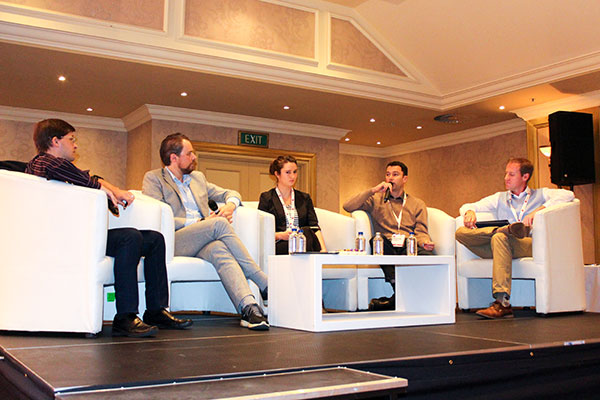
‘Disruption’ was the word of the day on the 30th of July as Footnote Summit 2015 kicked off in Johannesburg, Emperor’s Palace. Industry leaders, legends and organisations came together at Africa’s leading Digital Publishing event to tackle some of the industry’s toughest new challenges. This year saw speakers and panelists dealing with the physical and metaphysical challenges of the transformation of the book in this new environment where everything from the way the book looks, its distribution and sales model, to its consumption are digital. The world of the book is changing, and it with it. Publishers and technology providers are oftentimes at loggerheads as to where the book is going; at Footnote Summit the discussion tended toward finding the happy balance of collaboration in their entwined role in the future of the book.
Defining the future of the ‘book’
Mark Seabrook, Digital Director of Penguin Random House SA, brought to attention how the ‘book’ itself is difficult to define in its new climate. While many existing descriptions of ‘book’ remain outdated, focusing on its physical characteristics using terms like ‘print’, ‘pages’, ‘bound’, and ‘glued’, there are more accurate definitions that focus on its purpose such as ‘houses a story, or a collection of stories’. The future of the book was a hot topic for the panelists with Simon Bestbier, CEO of Realmdigital, noting that one of its functions would be to solve real world problems, such as literacy and education through interactivity. International speaker David Waweru, CEO of Wordalive Publishers in Kenya, spoke on the Kenyan experience and noted that digital reading on mobile has exploded in Kenya and is the possible new frontier for literacy in Africa. The future of the book does not seem to be defined by its trappings but rather by its function in society, and its potential is only limited by its creator.
The role of innovation
Discussions circled around the role of innovation in disrupting the book and where this innovation needed to come from; should the innovation be lead by the creators of the content or the technology providers who enhance, distribute and sell the content? It seemed that most were in accord that the responsibility of innovation lay with both parties, in that experts in publishing should team up with experts in technology. Tarryn-Anne Anderson of Snapplify also brought to attention that perhaps publishers were not thinking ‘out-of-thebox’ enough, and that the real innovation lay in new distribution methods. Many publishers felt that the industry needed smarter distribution and sales models, hinting at subscription models, short lease agreements, and distribution hardware.
e-Learning, pricing, and digital publishing perfection
While the theme of this Footnote Summit was not centered around education or eLearning, the topic came up often with reference to integrating analytics into digital reading for improving learners’ performance. Malcolm Seegers, Digital Publisher of Macmillan Education, commented that the future of the book is in analytics. Textbook creators could use this information and feedback to see how different parts of a book are being used by learners to improve their content. Finally, pricing models for digital content seemed a generic issue of publishers, with, as Mark Seabrook explained: authors screaming for higher royalties and readers screaming for cheaper prices. Although this is a big hurdle to acceptance of digital content the South African publishing industry seems to accept that there will be a degree of ‘messiness’ as the local digital publishing market matures. UK’s Henry Volans, director of Faber Press, highlighted this ‘messiness’ associated with digital publishing with his presentation on the quest for perfect digital publishing. He pointed out that the industry uses this imperfection as an excuse for retreating to the familiar, when it should just not expect too much too soon from digital platforms.
Last thought
The conference was well attended and featured thought-leaders as speakers and panelists from Macmillan Education, Siyavula Education, Van Schaik Bookstore, Faber Press, Oxford University Press, Pearson, Penguin Random House SA, Via Afrika, Books LIVE, Snapplify, Publishers’ Association of South Africa (PASA), and more.
Suhaifa Naidoo

Leave a Reply
Want to join the discussion?Feel free to contribute!