
Digital Technologies Summit
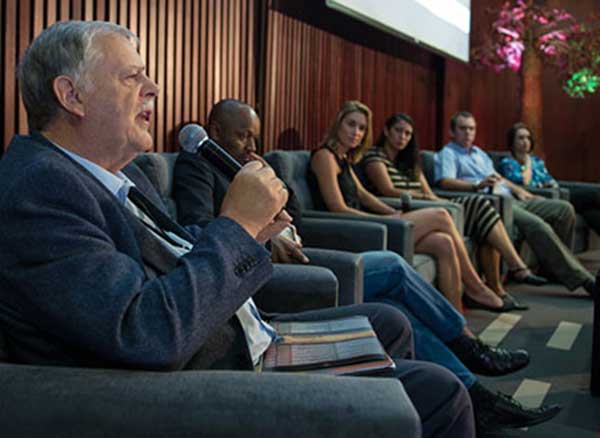
The Digital Technologies Summit took place on the 18th and 19th of March 2015, at the National Library of South Africa, Pretoria. Clearly, an event that addresses digital technologies and the technology-enabled future of the book industry in South Africa was long overdue. A number of industry and value-chain related challenges and opportunities exist for all role-players in the book sector when faced with digital technologies. In most instances, all are in agreement that digital technologies, although challenging to implement, bring far greater opportunities and solutions than problems and concerns. Nicolene Finlayson reports on the event.
The aim of the summit was to work towards a coherent digital strategy that serves the needs of all producers and users of books – individual readers of all ages, the book industry, institutions (libraries, educational bodies, corporates and others) and government. The focus was especially on digital books and digital content. In this regard the summit sought to, and succeeded in bringing together the various role-players in the digital book eco-system in order to focus on and discuss the current concerns and challenges faced by the book sector as a whole. Expert speakers and question-and-answer sessions allowed for in-depth, thoughtful and stimulating conversation throughout the two days of the conference. The summit succeeded in including a diverse list of speakers from within the digital book ecosystem, structured into 6 broadly themed sessions: An Overview, Publishing, Skills, Corporate, Education and Access & Use. PASA and SABA partnered with the SABDC to deliver the summit, with a grant made available by The Department of Arts and Culture (DAC). Government was represented by members of the departments of Arts and Culture, Trade and Industry, Telecommunications and Postal Services and Basic Education. Also present was Panyaza Lesufi (Gauteng MEC for Education), and this provided an open platform for members of industry to comment on the current implementation of digital education technology and content within Gauteng. The summit was well received with active participation and sound commitment from government. Glenn Masokoane of the DAC: “Thank you for the 6 point Action Points from the summit. By the way congratulations once more on what I think was a ground breaking summit of the sector and government. I’ll definitely go through the presentations once more and perhaps we need a post summit strategy for the way forward as this summit presented a number of policy related issues but also brought to the fore a number of very interesting possibilities for collaboration in developing sustainable e-book and related digital projects”.
Overview
Elitha van der Sandt, Chief Executive Officer: South African Book Development Council, opened with a presentation on how government can lead book development – her points included the need for adequate National Policy to be put in place to address the diverse challenges. At the heart of such a policy should be the promotion of books and a reading culture. Book development is a long-term intervention, and as such a wide array of financial schemes are required to encourage indigenous publishing, develop local infrastructure, address challenges in the local market, enact policy and develop schemes whereby book prices can be reduced, and to develop and promote children’s literature. The policy should also address the capacity building of professionals across the book value chain. Another part of growing local publishing – creating and expanding export markets for locally published books – was also touched upon.
Innovation skills
In a presentation by Elenor Jensen, Senior Manager at PricewaterhouseCoopers, she shed some perspective on the road to digital for the book publishing industry. According to Jensen, product and service innovation is the core of the growth strategy for many entertainment and media companies, especially traditional players. But to be truly innovative, she notes “you need a ‘learning capability’ that’s embedded throughout the enterprise, and enables wider innovation in areas from business models to metrics.” Fostering and driving diversity and knowledge sharing across all levels are pivotal to an organisation’s ability to build this capability – this includes giving people freedom to innovate, experiment and fail. Liam Borgstrom, lecturer in the University of Pretoria’s Department of Information Science’s Publishing division, noted that the summit displayed a deeply fragmented industry which, especially with regards to educational practice, needs to find a way to operate competitively within a collaborative space. Digital book content specifically has yet to stabilise in the way it has for much for academic journal publishing. South Africa is a unique position as far as localised content is concerned, and it was a theme within the summit that innovation in this area should be pursued. It also highlighted how much experimentation is taking place amongst different industry role players. There is a keen movement towards promoting digital literacy and a number of solutions to digital content distribution are being devised. Mr Borgstrom also presented at the summit.
South African authors ready for turbulence
Professor Sihawukele Ngubane, Chairman: Academic and Non-Fiction Authors’ Association of South Africa (ANFASA), asked in his presentation whether South African authors are ready for digital turbulence – to be shaken up by, respond to, and overcome technological challenges. Authors, he said, are at the heart of the book value chain – they are the “engine” that delivers content. As such, they have no choice but to accept the changes. One way that academic authors are affected by changes in the publication process is the speed of publication. Journals, especially, are published much more quickly. Previously, reduction of a manuscript to the published article took weeks or even months, including a long peer review process. Now, the process can take days or even hours. Reviewers have to be fast or they will be left out of the loop. Authors are wary of this speeding up, asking whether speed will take precedence over quality – does this mean shorter articles, dumbing down of content, and less rigorous research? As analogue formats give way to digital platforms the world opens up to new ways of disseminating and receiving information and entertainment. On the one hand, the digital divide reflects the difference in reading practice between poor and rich, rural and urban areas; on the other hand, South Africa has very high cellphone penetration, into deeply rural areas. Socio-economic factors such as poverty, inadequate education and infrastructural under-development have created a society divided into information rich and information poor.
Much of the population cannot easily access and utilise print. But they can read on their cellphones. What does this mean to authors? Obviously, it means that they can reach new audiences. One of those audiences is the youth readership. Young people take their cellphones everywhere. Information is mobile. Everyone is an author, communicating through words. In fact, the young reader/writers are not the generation that needs to prepare itself for the digital era. It is in their blood.
Access & use
One of the biggest problems in the South African book landscape is the lack of a vibrant reading community. Mignon Hardie, Trust manager for FunDza, believes that although they are trying to change the status quo, more needs to be done. In her presentation, she pointed out that reading behaviour is also a factor of a range of environmental and economic issues – many people don’t read and aren’t proficient at reading because of poverty – they cannot afford to buy books, they cannot afford to go to schools with qualified teachers and reading resources, their parents can’t read, the local library is under-stocked, and many more reasons. Siyavula is a social enterprise built on community, openness and technology. Megan Beckett, Instructional Designer at Siyavula, was at the summit to share their social mission – “To make high quality education accessible to every learner and teacher in South Africa.” One of Siyavula’s key principles is openness – but what is Open education and content?
Basically, it describes practices and initiatives that broaden access to the learning and training tradionally offered through formal education systems. Educators and learners that use Open Education Resources (OER) do not need to pay royalties, and they are free to reuse, remix, revise, and redistribute materials to fit their needs. In a country with multiple level challenges and barriers to education, this seems perfect. The cost of access can be reduced, and teachers can adapt and develop materials relevant to their learners. “Openness” as a business model has a lot of potential for far reaching impact in South Africa – from making education more accessible, allowing for better collaboration, embracing an online culture of sharing, moving forward and driving innovation, and ultimately, competing internationally.
Last thought
It seems like one of the most dwelled upon statements of the summit was the need for innovation – in all spheres of the book eco-system, it needs to be fast tracked – new business models must be developed, entrepreneurship should be encouraged and fostered, and better research into consumer’s digital behavior should be undertaken. Once these aims and outcomes are clarified, a regulatory environment should be put in place to support and uphold them, which will ultimately lead to a more coherent, more relevant, South African Book value chain.
The full report on the Digital Technologies
Summit is available on the SABDC website
SABDC Digital Summit

Leave a Reply
Want to join the discussion?Feel free to contribute!